Digital Thermostats
Siemens RDF310 Replacement Guide: How to Select a Compatible Fan Coil Thermostat
The Siemens RDF310 has been widely used in hotels, offices, apartments and commercial buildings for controlling 2-pipe fan coil units.
When an RDF310 fails or becomes difficult to source, many buyers begin looking for an alternative. The main challenge is that a thermostat with a similar appearance may not necessarily work with the existing fan coil unit.
To find a suitable Siemens RDF310 replacement, you need to check the electrical and control requirements first.
Quick Answer
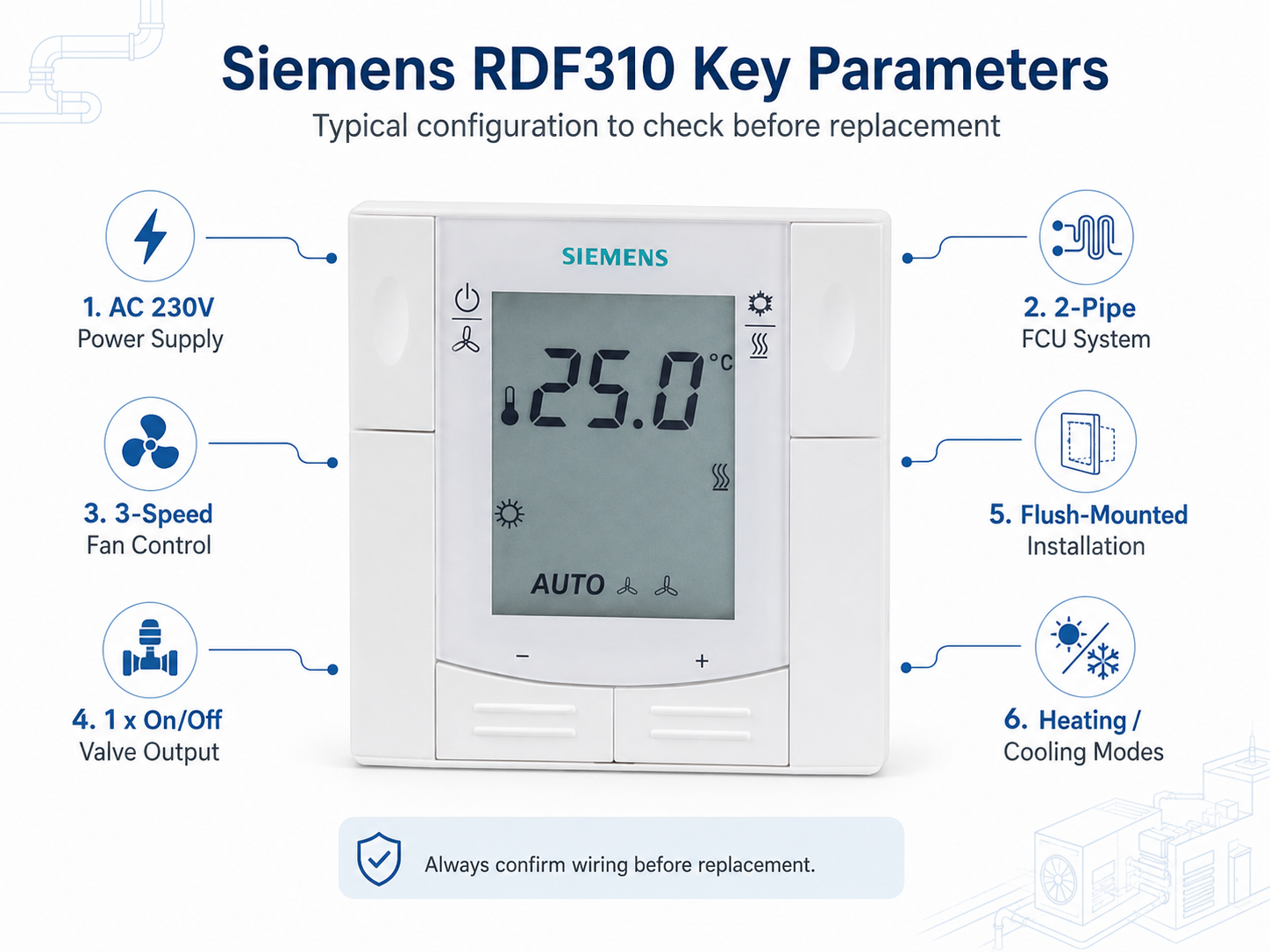
A typical replacement for the Siemens RDF310 should support:
- ● AC 230V power supply
- ● 2-pipe fan coil systems
- ● Three-speed AC fan control
- ● One on/off valve output
- ● Heating and cooling modes
- ● Flush-mounted installation
However, the final selection should always be based on the existing wiring and fan coil configuration.
The model number alone is not enough to confirm compatibility.
What Does the Siemens RDF310 Control?
The Siemens RDF310 is mainly used with 2-pipe fan coil units.
In a typical installation, it controls:
- ● One three-speed fan
- ● One on/off valve actuator
- ● Room temperature
- ● Heating or cooling operation
The fan normally has three separate speed wires:
- ● Low
- ● Medium
- ● High
The thermostat switches power to one fan-speed terminal at a time.
The valve output opens or closes the water valve according to room temperature and the selected operating mode.
This is a relatively common FCU control arrangement, which means replacement options are available. The important point is to match the control method correctly.
Siemens RDF310 Replacement Checklist
Before choosing a replacement thermostat, confirm the following five items.
| Item to check | Typical RDF310 configuration |
|---|---|
| Power supply | AC 230V |
| FCU system | 2-pipe |
| Fan control | Three-speed AC fan |
| Valve control | AC 230V on/off |
| Installation | Flush mounted |
If all five items match, finding a suitable alternative is usually straightforward.
If one of them is different, the replacement may require a different thermostat version or changes to the wiring.
1. Check the Power Supply
The standard Siemens RDF310 operates with an AC 230V power supply.
The replacement thermostat should therefore also support AC 220–230V.
This may sound obvious, but power-supply mismatch is one of the most common mistakes in thermostat replacement projects.
Some room thermostats operate on:
- ● AC 24V
- ● DC 24V
- ● Battery power
- ● AC 230V
These products are not directly interchangeable.
Before placing an order, check the model label, wiring diagram or actual voltage at the installation site.
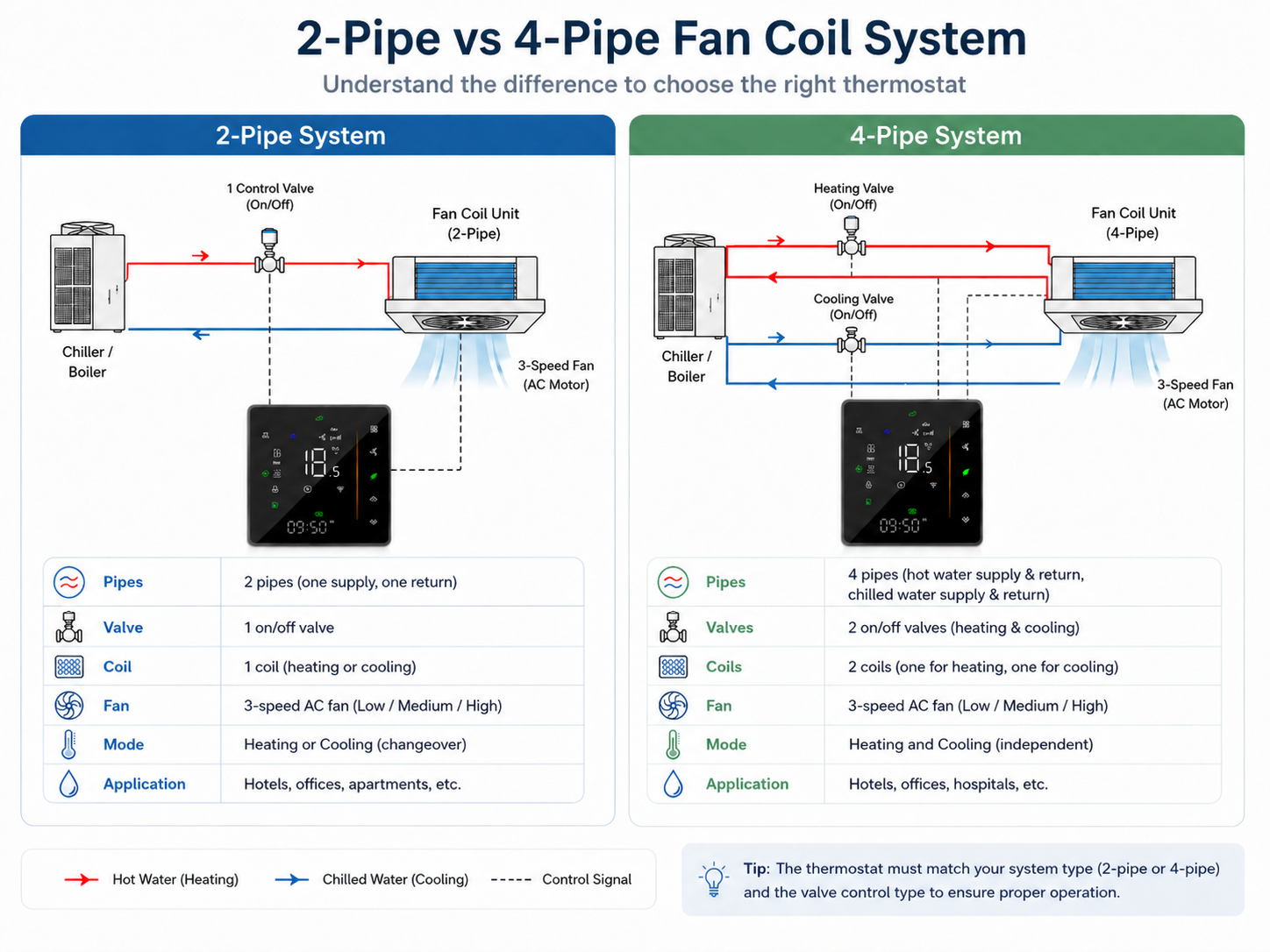
2. Confirm Whether the FCU Is 2-Pipe or 4-Pipe
The Siemens RDF310 is mainly designed for a 2-pipe fan coil system.
A 2-pipe FCU normally has one water coil and one controlled valve. The same pipework supplies chilled water in summer and hot water in winter.
A 4-pipe system has separate heating and cooling coils. It normally requires two valve outputs:
- ● One cooling-valve output
- ● One heating-valve output
This means a basic 2-pipe thermostat cannot directly control a standard 4-pipe FCU.
A simple way to check is to look at the number of valve wires or valve actuators:
- ● One controlled valve usually indicates a 2-pipe system.
- ● Two controlled valves usually indicate a 4-pipe system.
When the system type is unclear, the FCU wiring diagram is the most reliable reference.
3. Identify the Fan Type
The RDF310 is commonly used with a three-speed AC fan motor.
This type of fan has separate connections for low, medium and high speed. The thermostat selects the required speed by energizing the corresponding output.
A compatible replacement should therefore provide three line-voltage fan outputs.
Do not confuse this with an EC fan.
An EC fan usually uses a 0–10V control signal instead of three separate speed outputs. A standard three-speed thermostat cannot directly provide proper variable-speed control for an EC fan.
Before replacement, confirm whether the fan is:
- ● Three-speed AC
- ● Single-speed AC
- ● 0–10V EC fan
For most traditional RDF310 installations, it will be a three-speed AC fan.
4. Check the Valve Voltage and Control Type
A typical Siemens RDF310 installation uses one AC 230V on/off valve actuator.
The control logic is simple:
- ● The thermostat sends power to the valve when heating or cooling is required.
- ● The valve closes when the room reaches the set temperature.
However, not every fan coil valve works in the same way.
Common valve-control types include:
- ● AC 230V on/off
- ● AC 24V on/off
- ● Three-point floating control
- ● DC 0–10V modulating control
A replacement thermostat must provide the correct output for the installed actuator.
For example, a 230V on/off thermostat cannot directly replace a controller for a 0–10V valve.
It is also useful to confirm whether the actuator is normally closed or normally open. Most common fan coil applications use normally closed actuators, but this should not be assumed without checking.
5. Compare the Wiring Functions
Different thermostat brands use different terminal names.
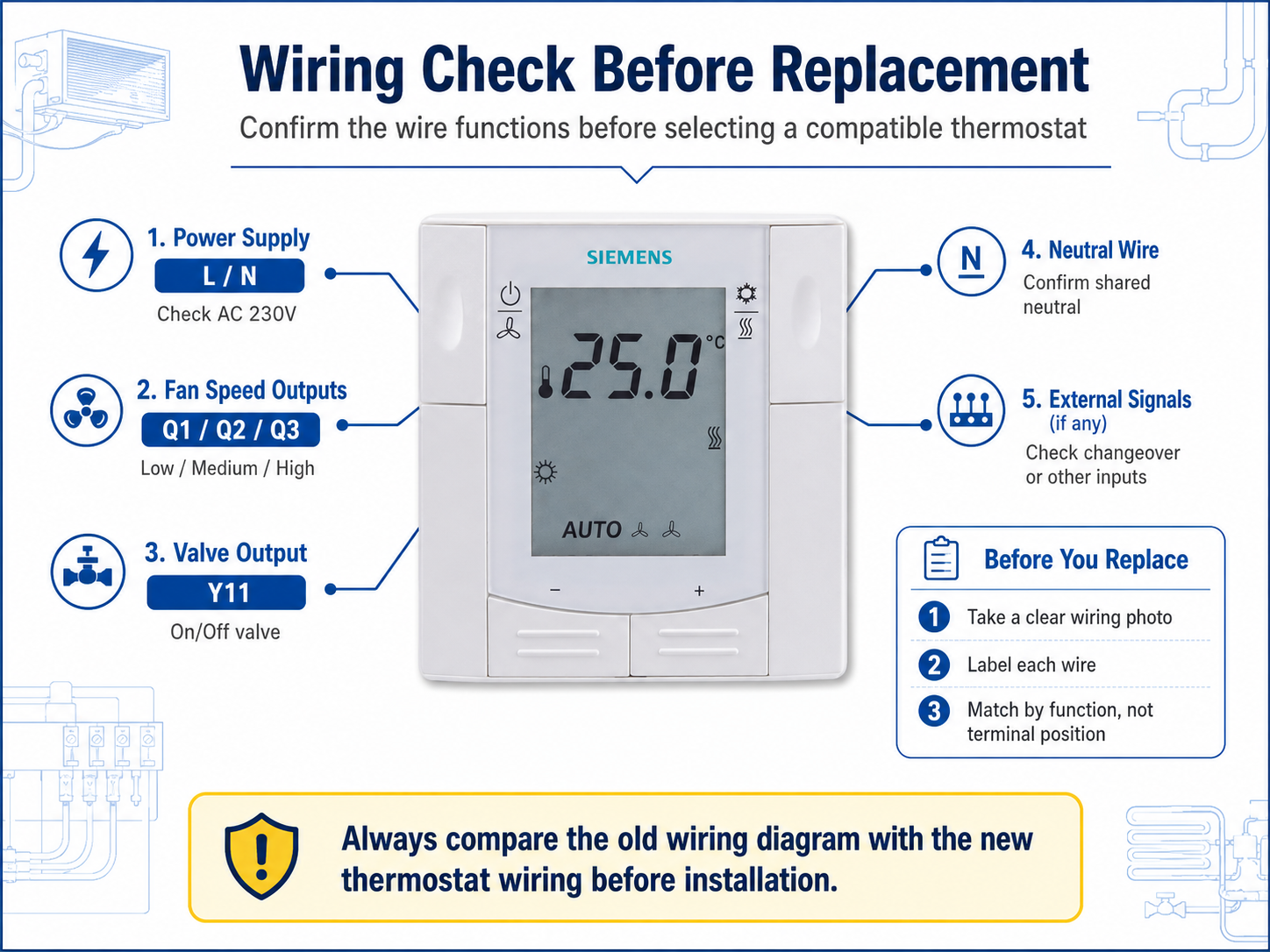
On the Siemens RDF310, the terminals may include connections for:
- ● Live and neutral power
- ● Low fan speed
- ● Medium fan speed
- ● High fan speed
- ● Valve output
Another thermostat may label the same functions as:
- ● L and N
- ● LOW, MED and HIGH
- ● V1
- ● VALVE
- ● FAN 1, FAN 2 and FAN 3
The labels and positions may be different even when the functions are the same.
This is why wires should never be transferred only according to terminal position.
Before removing the original thermostat:
Take a clear photo of the wiring.
Mark each wire according to its function.
Compare the old and new wiring diagrams.
Confirm the fan and valve outputs.
Test every function after installation.
Because the thermostat may carry mains voltage, installation should be completed by a qualified technician.
Will an 86 × 86 mm Thermostat Fit?
The RDF310 uses a common square wall-mounted design, with a front size of approximately 86 × 86 mm.
Many modern FCU thermostats use a similar faceplate size. However, the same front dimensions do not guarantee a perfect mechanical fit.
You should also compare:
- ● Mounting screw distance
- ● Backplate dimensions
- ● Wall-box depth
- ● Cable-entry position
- ● Space for terminals and wires
For a renovation project, it is best to request a dimensional drawing or test one sample before ordering the full quantity.
In some cases, the new thermostat can cover the original wall opening but may still require a different mounting bracket or box.
Can a Smart Thermostat Replace the RDF310?
Yes, a Wi-Fi, Modbus or BACnet thermostat can replace an RDF310, provided the basic electrical outputs remain compatible.
For example, a Wi-Fi FCU thermostat may still use:
- ● AC 230V power
- ● Three-speed fan outputs
- ● One on/off valve output
The Wi-Fi function simply adds remote control and scheduling.
A replacement project can also be an opportunity to add features such as:
- ● Mobile app control
- ● Weekly programming
- ● Keycard input
- ● Window contact
- ● External temperature sensor
- ● Modbus RTU
- ● BACnet MS/TP
- ● Central setpoint control
However, more features also mean more commissioning work.
If the project only requires a reliable replacement for a failed thermostat, a simple standalone model may be the better choice.
If the building is being upgraded or connected to a BMS, a communication version may provide more long-term value.
For a broader comparison of commercial fan coil thermostat options, see our FCU thermostat selection and comparison guide.
Can Beris Thermostats Be Used as an RDF310 Alternative?
Beris Tech provides FCU thermostats for different fan, valve and communication configurations.
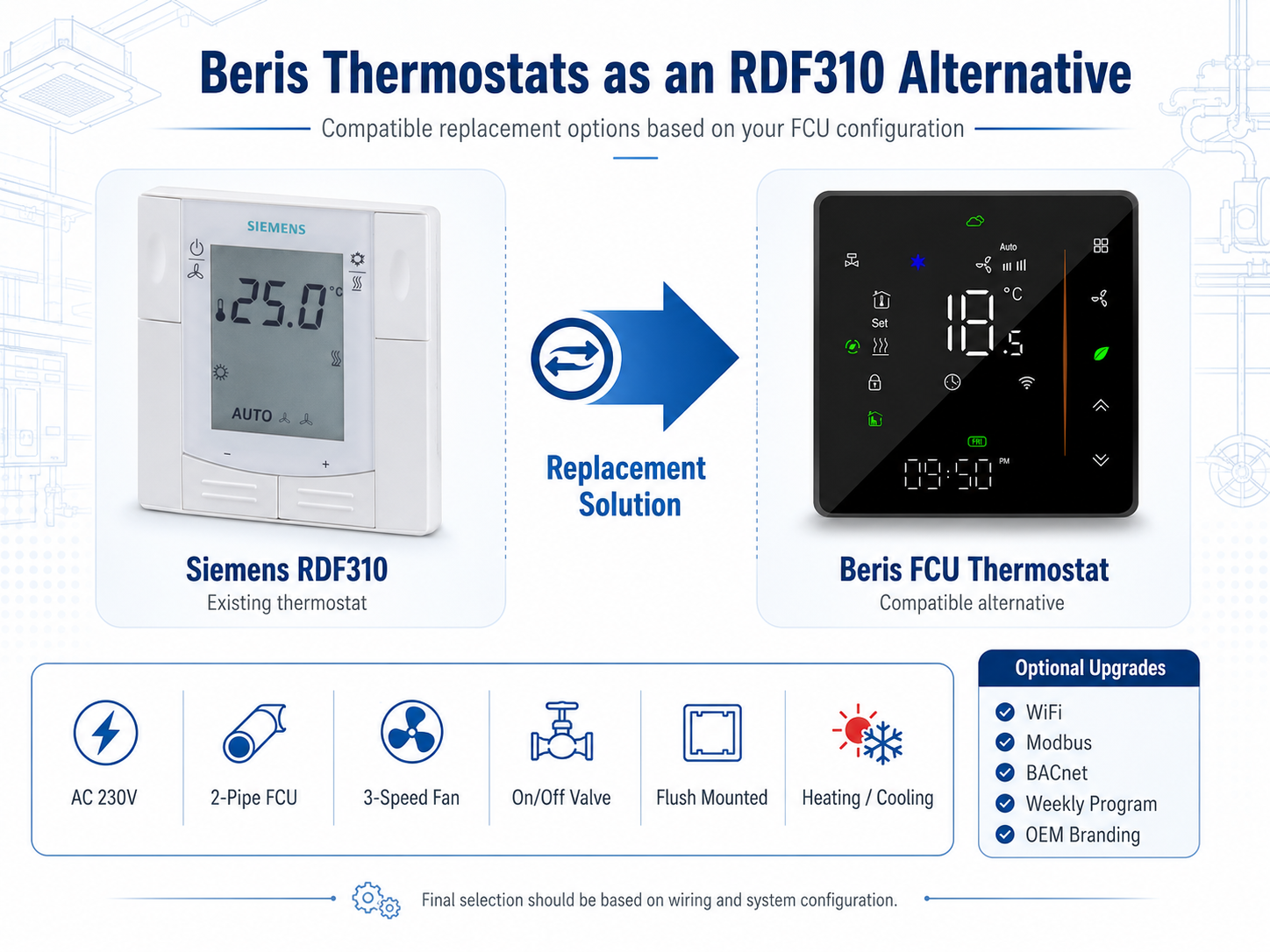
For a typical Siemens RDF310 replacement, we would normally look for a thermostat with:
- ● AC 230V input
- ● 2-pipe FCU control
- ● Three-speed AC fan outputs
- ● One on/off valve output
- ● Heating and cooling modes
- ● Flush-mounted installation
Wi-Fi, Modbus or BACnet versions can also be considered when the project requires remote or centralized control.
However, we do not recommend selecting a model only from the name “RDF310.”
The existing wiring should be checked first because building projects may use different valve actuators, fan motors or control sequences even when the same Siemens thermostat is installed.
What Information Should You Provide?
To recommend a suitable replacement, the following information is usually enough:
- ● A photo of the existing thermostat wiring
- ● The full Siemens model number
- ● The FCU wiring diagram, if available
- ● Power-supply voltage
- ● 2-pipe or 4-pipe system
- ● Valve voltage and control type
- ● Fan type
- ● Required quantity
For most replacement projects, a clear wiring photo can answer many of these questions.
Test Before Bulk Replacement
Even when the specifications look compatible, we recommend testing one or two samples before replacing thermostats throughout a building.
The sample should be tested for:
- ● Power-on operation
- ● Temperature accuracy
- ● Heating mode
- ● Cooling mode
- ● Low fan speed
- ● Medium fan speed
- ● High fan speed
- ● Automatic fan operation
- ● Valve opening and closing
- ● Installation fit
This is especially important for hotels, offices and apartment projects where many thermostats will use the same wiring.
A successful sample test reduces installation risks and avoids expensive changes later.
Frequently Asked Questions
Is the Siemens RDF310 for a 2-pipe or 4-pipe FCU?
The RDF310 is mainly used for 2-pipe fan coil systems with one valve output.
For a 4-pipe system, a thermostat with separate heating and cooling valve outputs is normally required.
What voltage does the RDF310 use?
The standard RDF310 uses AC 230V power.
The exact model and site voltage should still be checked before replacement.
Does the RDF310 control a three-speed fan?
Yes. It is commonly used to control low, medium and high speeds of a three-speed AC fan.
Can a Wi-Fi thermostat replace it?
Yes, as long as the Wi-Fi thermostat has compatible power, fan and valve outputs.
Wi-Fi is an additional feature. It does not replace the need for electrical compatibility.
Can a Modbus thermostat replace it?
Yes, a Modbus FCU thermostat may be used when its local fan and valve outputs match the original system.
RS485 wiring and BMS programming will be required if the communication function is used.
Can the original wires be reused?
In many projects, yes.
However, the wires must be connected according to their functions, not according to the old terminal positions.
Should I order a sample first?
Yes. Testing one or two samples is strongly recommended before a bulk replacement order.
Conclusion
A suitable Siemens RDF310 replacement should match the fan coil system rather than simply look similar to the original thermostat.
For a typical installation, the most important requirements are:
- ● AC 230V power
- ● 2-pipe FCU control
- ● Three-speed AC fan outputs
- ● One compatible on/off valve output
- ● Suitable mounting dimensions
Checking the wiring before model selection is the safest and fastest approach.
If you are looking for a Siemens RDF310 alternative, send us a photo of the existing wiring and the project quantity. Beris Tech can help you identify a suitable FCU thermostat for testing.